
How to Audit Your Website for AI Answer Engines (Perplexity, Gemini & Search Overviews)
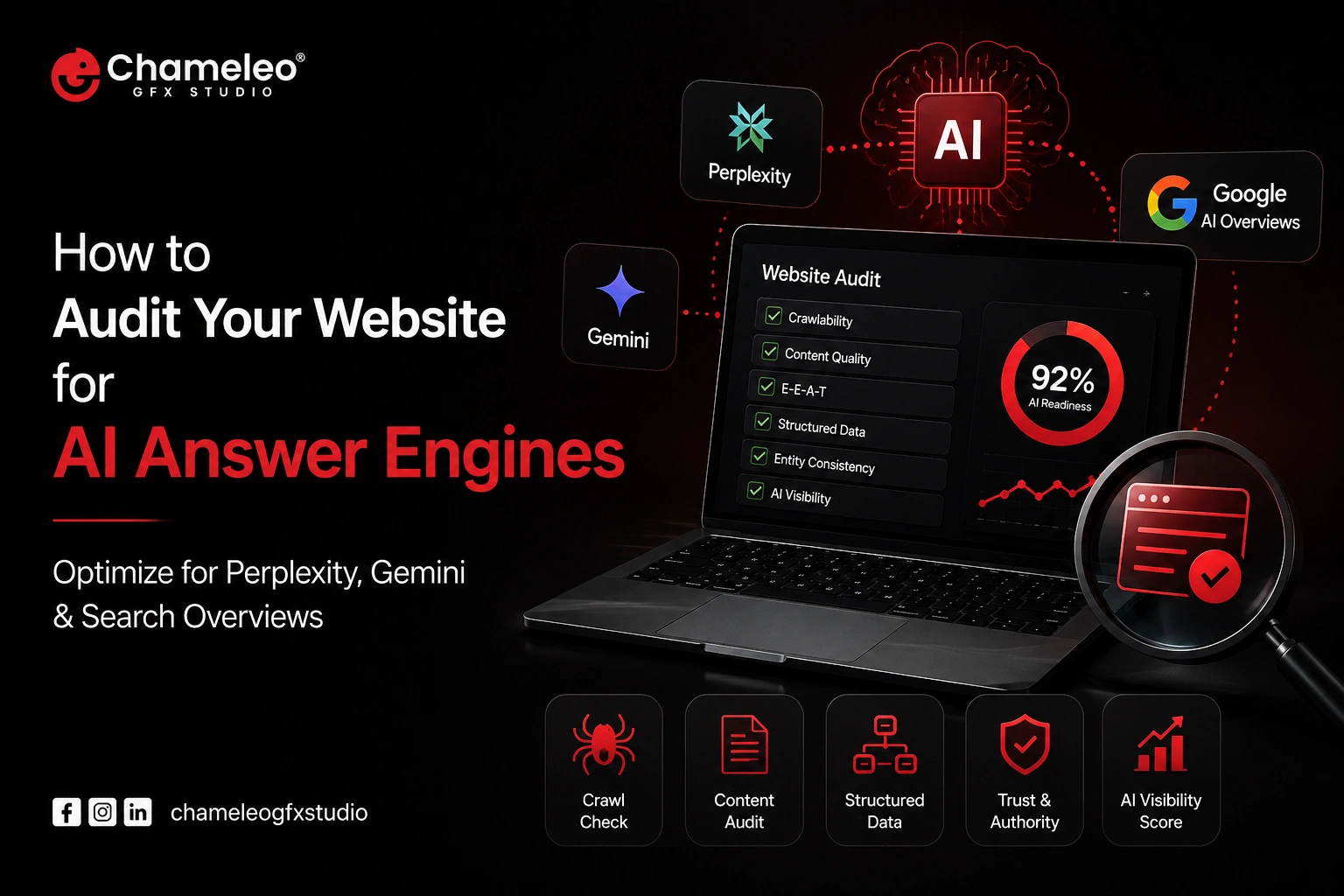
For years, a website audit meant checking title tags, page speed, backlinks, and keyword rankings. That list still matters, but it is no longer complete. AI Overviews, Perplexity, Gemini, and ChatGPT now answer questions directly, often pulling information from a handful of sources and presenting it before a user ever clicks a blue link. If your content is not built in a way these systems can parse, trust, and reuse, you can rank well in traditional search and still be invisible in the answer itself.
That is the gap an AI search audit is meant to close. It does not replace a traditional SEO audit. It sits alongside it, checking whether your content, structure, and technical foundation are actually usable by systems that summarize, cite, or ignore your pages in real time.
Table of Contents
- What Is an AI Search Audit?
- Why AI Search Optimization Matters
- How to Conduct an AI Answer Engine Optimization Audit
- How to Audit Your Website for Perplexity, Gemini, and Google AI Overviews
- Pro Tip for Improving AI Search Visibility
- Common AI Search Audit Mistakes
- Frequently Asked Questions
- Conclusion
What Is an AI Search Audit?
An AI search audit examines your website through the lens of how generative systems retrieve and use information, rather than how a traditional ranking algorithm scores a page.
A conventional SEO audit asks questions like: does this page rank for its target keyword, is the page speed acceptable, are there broken links? An AI search audit asks a different set of questions: can a crawler actually access this content, is the answer to the user's question stated plainly near the top of the page, does the page support its claims with something more substantial than opinion, and is the entity behind the content (your business, your author, your brand) consistently described across the web.
In practice, this means reviewing your content for direct answers, checking your markup for structured data, confirming that AI crawlers are not blocked, and looking at whether your site reads as a coherent, trustworthy source on its topic rather than a collection of disconnected pages built around keywords.
This is where an AI search audit differs most from a legacy SEO checklist. Ranking position still matters, but ranking is no longer the only outcome that determines whether users see your content. Google itself has said the same core SEO fundamentals apply to its generative features, and there are no separate technical requirements specifically for appearing in AI Overviews or AI Mode.
Why AI Search Optimization Matters
People are increasingly asking questions in AI interfaces and expecting a direct answer, not a list of ten links to sort through. That shift is changing how content gets discovered, cited, or skipped entirely.
This does not mean traditional search traffic is disappearing, and it would be irresponsible to claim otherwise. What is happening is more subtle: search behavior is fragmenting across more surfaces. A user might get a quick answer from an AI Overview, do deeper research in Perplexity, and cross-check a claim in Gemini before ever landing on a website. If your content is not structured to be picked up by any of those systems, you lose the chance to be part of that research process, even if your traditional rankings look healthy.
AI search optimization matters because it protects visibility across a search landscape that no longer runs through a single channel. It is not about chasing a new algorithm. It is about making sure the content you have already invested in is actually legible to the systems now standing between your business and your audience.
How to Conduct an AI Answer Engine Optimization Audit
A useful AI answer engine optimization audit works through the site in layers, from technical access down to the substance of the content itself.
- Crawlability and indexability: Confirm that AI crawlers and traditional search bots can reach your pages. Check your robots.txt file for accidental blocks, review server logs if you have access to them, and verify that key pages are not sitting behind JavaScript rendering that a crawler might not execute.
- Content quality and search intent: Read your top pages as a stranger would. Does the page actually satisfy the question a searcher is likely asking, or does it circle around the topic without committing to an answer?
- Direct answers and information completeness: Look for a clear, direct answer near the top of the page, ideally within the first few sentences of a section. Weak content buries the answer under three paragraphs of preamble. Strong content states it plainly, then expands with detail.
- E E A T and first-hand experience: Check whether the content reflects real experience: specific examples, realistic scenarios, and details that could only come from someone who has actually done the work. Generic advice that could apply to any industry is a signal of weak E E A T.
- Entity and topical authority: Review whether your brand, authors, and core topics are described consistently across your site and around the web. Inconsistent naming or scattered topic coverage makes it harder for AI systems to build a confident picture of what your business does.
- Structured data and machine-readable information: Audit your schema markup for accuracy. Organization, Article, FAQ, and Product schema (where relevant) help systems understand what a page contains without guessing.
- Internal linking and content relationships: Check whether related pages link to each other in a way that reinforces topical clusters, rather than existing as isolated posts with no connective structure.
- Citations and authoritative references: Review whether your content references credible external sources where appropriate. Content that never points to anything beyond itself can read as less trustworthy to both human readers and AI systems evaluating authority.
- Brand mentions and entity consistency: Search for how your brand is mentioned across directories, press, and partner sites. Inconsistent business names, addresses, or descriptions dilute entity clarity.
- AI crawler accessibility: Specifically check whether known AI crawler user agents are blocked in your robots.txt, since some sites block these by default without realizing it.
- Technical SEO: Confirm your site still meets core technical standards: valid HTML, mobile usability, secure connections, and reasonable load times.
- Content freshness: Identify pages with outdated statistics, old screenshots, or superseded information, and prioritize updates on pages that matter most to your business.
- AI Overview and answer engine visibility testing: Manually search your target queries in Google, Perplexity, and Gemini to see what currently appears. This will not tell you why a competitor is cited and you are not, but it gives you a realistic baseline.
How to Audit Your Website for Perplexity, Gemini, and Google AI Overviews
Each platform pulls information a little differently, so it helps to check your site against what each one tends to reward.
| Platform | What to Audit | What Strong Content Looks Like |
|---|---|---|
| Google AI Overviews | Structured data, page experience, existing organic rankings, direct answer placement | Content that already performs well organically, answers the query directly, and follows Google's standard SEO fundamentals. |
| Perplexity | Citation-worthy content, clear sourcing, factual accuracy, recent publication dates | Well-sourced articles with credible references, transparent authorship, and up-to-date information |
| Google Gemini | Entity clarity, topical depth, structured content, consistency with the Knowledge Graph | Pages that clearly define entities and relationships, supported by consistent information across the web |
No structured data, content format, or technical setup guarantees inclusion or citation on any platform. These are signals that tend to correlate with stronger visibility, not a formula.
Common AI Search Audit Mistakes
- Writing only for keywords. Content built around keyword density rather than a genuine answer reads as thin to both users and AI systems.
- Creating generic AI-generated content. Unedited, templated writing lacks the specificity that signals real expertise.
- Ignoring first-hand experience. Advice with no grounding in actual practice is harder to trust and easier to overlook.
- Publishing unsupported claims. Statistics or statements without a credible source undermine trustworthiness.
- Neglecting entities. Inconsistent business information across the web confuses systems trying to understand who you are.
- Ignoring technical SEO. No amount of well-written content matters if crawlers cannot access it.
- Creating content without clear answers. Vague, meandering pages make it harder for any system to extract a usable answer.
- Focusing only on Google rankings. Optimizing exclusively for one platform ignores the reality of a fragmented search landscape.
- Assuming AI citations work exactly like traditional rankings. Ranking well organically does not automatically translate into being cited or summarized in an AI response.
For businesses that want professional support, working with an AI search engine optimization agency in Ahmedabad can provide a more structured approach to auditing technical SEO, content, entities, and AI search visibility. The goal should not simply be to add another SEO checklist. It should be to identify where your website is difficult for both people and modern search systems to understand, then fix those gaps with useful, authoritative content.
Key Takeaways
- An AI search audit checks whether content can be read, understood, and reused by answer engines.
- Crawlability, structured data, clean HTML, and direct answers are essential foundations.
- E-E-A-T, first-hand experience, and consistent entity signals still matter.
- No optimization technique can guarantee a citation or inclusion.
- AI search optimization extends solid technical SEO rather than replacing it.
Frequently Asked Questions
Conclusion
Auditing a website for AI answer engines is less about chasing a new set of tricks and more about applying an old discipline more carefully. Crawlability, structured data, direct answers, and genuine expertise were always part of good SEO. What has changed is the number of surfaces evaluating that work, from Google AI Overviews to Perplexity to Gemini, each deciding in real time whether your content is worth summarizing or citing.
Chameleo GFX Studio approaches this as an extension of solid technical and content strategy, not a separate specialty with shortcuts. Businesses that treat AI search optimization as an excuse to skip the fundamentals tend to see the gap between their content and their competitors widen, not close.
If you want a clear picture of how your website performs across traditional search and AI answer engines, Chameleo GFX Studio can walk through an audit with you and outline practical next steps based on what your site actually needs. Contact us or call +91 973 747 2636.