
The New SEO Problem Nobody Is Talking About: Your Website Isn't Being Cited by AI
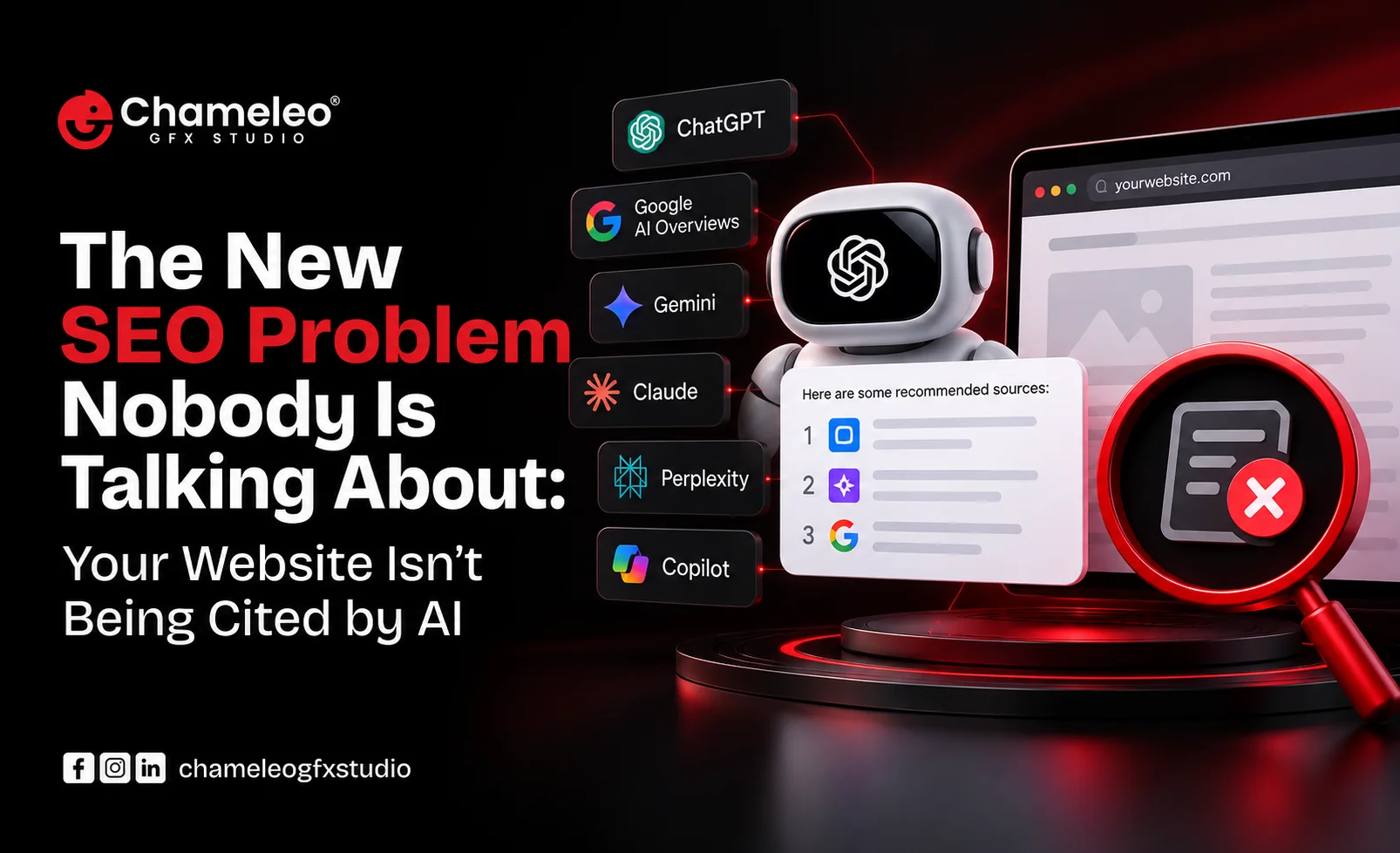
You can rank well on Google and still be missing from the answer a customer actually reads. Many people now ask ChatGPT, Google AI Overviews, Perplexity, or Microsoft Copilot a question and get a written response with a few sources attached. If your business is not among them, a competitor with weaker rankings might be.
Standard rank reports will not show that gap. This article explains what AI search visibility means, why some sites earn AI citations while others are passed over, and what you can change on your own website. It separates documented facts from industry guesswork, of which there is plenty.
Table of Contents
- What AI Search Visibility Actually Means
- Why Ranking on Google Is No Longer the Whole Story
- Why AI Platforms Cite Some Websites and Ignore Others
- How AI Search Optimization Differs From Traditional SEO
- How to Optimize Your Website for AI Search
- The Role of Content, Entities, Structure and Trust
- What Businesses Should Measure Beyond Rankings
- AI Search Visibility: What to Do Next
- Frequently Asked Questions
- Conclusion
What AI Search Visibility Actually Means
AI search visibility is how often, and how accurately, your brand and pages appear inside AI-generated answers. That might be a linked citation under a Google AI Overview, a source card in Perplexity, a footnote in ChatGPT, or your company named with no link at all.
A citation is a visible reference to one of your pages. A mention is your brand named in the answer text. Neither equals traffic: a citation does not necessarily represent clicks or engagement.
In practice, it is a chain. An AI system must find your content, understand who you are, trust the material enough to use it, and credit you. A break at any link ends the process.
Why Ranking on Google Is No Longer the Whole Story
Google's documentation says AI Overviews and AI Mode may use query fan-out, running several related searches across subtopics before writing a response, and can show a wider set of links than a classic search. A page may therefore be cited for one narrow sub-question it answers well, even if it is not the top result for the main keyword.
The reverse also happens. Picture a hypothetical accounting firm that ranks well for its core services, but whose long, vague pages never clearly answer which documents are needed to register a company. A competitor with a short, direct guide gives an AI system cleaner material. This is an illustration, not a client result.
Traditional SEO remains the foundation. Google says its usual best practices still apply to AI features and that no extra requirements exist. Other platforms, though, run their own systems, so doing well on one engine settles nothing on another.
Why AI Platforms Cite Some Websites and Ignore Others
No platform has published a full formula, and anyone claiming one is guessing. There are documented access requirements and reasonable inferences, but they should not be confused with confirmed ranking factors.
The gates come first because a page must be reachable.OpenAI's publisher guidancesays to avoid blocking OAI-SearchBot if you want content in ChatGPT search summaries, and its crawler overview describes each crawler setting as independent.Perplexity recommends allowing PerplexityBot and its published IP ranges. Microsoft offers an AI Performance report in Bing Webmaster Tools showing how content is referenced in its AI experiences, including Copilot. Google AI Overviews and AI Mode draw on Google Search, so normal indexing applies. Gemini is Google's assistant, and its use of web content can vary by product, so check current documentation.
Beyond access, useful practices include making answers easy to extract, keeping facts about your business consistent, referencing reputable sources, and publishing content that genuinely adds something useful. These are sound publishing practices, not a guaranteed formula for citations.
How AI Search Optimization Differs From Traditional SEO
| Area | Traditional SEO Focus | AI Search Focus |
|---|---|---|
| Unit of competition | A page ranking for a keyword | A passage or fact that answers a sub-question |
| Success signal | Position and clicks | Citations, brand mentions and referrals |
| Content shape | Comprehensive pages | Direct answers backed by supporting depth |
| Trust evidence | Links and reputation | Consistent entity details and reputable references |
None of this replaces keyword research or technical SEO. It sits on top of them.
How to Optimize Your Website for AI Search
Start with access
Review your robots.txt, CDN and firewall rules, and XML sitemap. Confirm that Googlebot, Bingbot, OAI-SearchBot, and PerplexityBot are not blocked by accident. Decide separately whether you want to allow training crawlers such as GPTBot.
Write answers that stand alone.
Put the direct answer in the first sentence under a question-style heading, then add detail, examples, and limits. A paragraph that still makes sense when lifted out of the page is easier to reuse. Answer first, depth second.
Add structured data where it is true.
Use JSON-LD for types such as Organization, LocalBusiness, or Article only when it matches what visitors can see. Google warns against marking up information that is not visible. Schema.org supplies the vocabulary, but Google's documentation governs Google Search. Markup helps machines read a page. It does not guarantee citations.
Keep business facts consistent.
Use the same name, address, phone number, and service descriptions on your site, Google Business Profile, Bing Places, and major directories. Add an About page with named people and credentials, and a clear Contact page.
The Role of Content, Entities, Structure and Trust
An entity is a distinct thing a system can recognize: your company, a founder, a product, a location. If your pages describe the business differently in different places, a system struggles to decide what you are credible for. State plainly what you do, for whom and where, and connect related pages with descriptive internal links. Topical authority comes from depth across a subject, not one enormous page.
Length is not a strategy. A 600-word page with a clear answer, a named author, and a cited source can serve better than 3,000 words of padding. Update pages when facts change.
Trust also lives off your site: reviews, directories, credible press, and genuine mentions. Earn them through useful work, because manufactured mentions tend to age badly.
What Businesses Should Measure Beyond Rankings
Rank trackers will not show whether you are cited. These signals can:
- Google Search Console: where Google has begun rolling out Generative AI impression reports to a subset of sites.
- Bing Webmaster Tools: Tools citation and grounding query data.
- Analytics referrals: From AI platforms, treated as a minimum since referrer data is inconsistent.
- Server logs: Logs showing AI-related crawler visits.
- Real customer questions: A monthly test of real customer questions across platforms, with dates recorded.
AI answers can vary by person and time, so track trends rather than treating a single result as a permanent ranking.
AI Search Visibility: What to Do Next
A practical first month can focus on a small set of high-value improvements:
- Audit crawler access and indexing in Google and Bing.
- Rewrite the openings of your ten most valuable pages so they answer the core question directly.
- Fix entity basics: About page, contact details, authors, and consistent business listings.
- Add accurate structured data to the pages where it genuinely describes visible content.
- Start a monthly question test list and log how your brand and pages appear across relevant AI search experiences.
Much of this can be done internally. If you lack the technical or content capacity, Chameleo GFX Studio can review crawl access, content structure, and markup within a broader website and SEO plan.
Pro Tip
Take one important service page and read only its first two sentences. If those sentences appeared alone in an AI answer, would a stranger know who the business is, what it offers, where it operates, and what supports the claim? If not, rewrite them to name the business, state the offer plainly, and add one verifiable detail, such as a certification, a published policy, or a link to a primary source.
Key Takeaways
- Ranking on Google and being cited in AI answers are related outcomes, but they are not the same outcome.
- Google's established SEO fundamentals remain relevant to AI search, while ChatGPT, Perplexity, Copilot, and other platforms have their own systems.
- Access comes first. A robots.txt rule or firewall setting can quietly block crawlers that support AI search.
- Answer first: clear writing, consistent business facts, and honest structured data make a page easier for machines to interpret.
- Measure citations, brand mentions, crawler activity, and real customer questions, not only keyword positions.
Frequently Asked Questions
Conclusion
Ranking is still worth pursuing, but it is no longer the only measure of whether people find you. Businesses that want to remain visible in AI search need websites that are helpful, clear, credible, technically accessible, rich in entity detail, well structured, and backed by trustworthy information.
None of that is a trick. It is good publishing done with machines in mind as well as people. Start with access and clarity, measure honestly, and be patient with a fast-moving area.
Start Improving Your AI Search Visibility
If you would like an honest look at how your website appears to search engines and AI answer engines, share your website, SEO, or digital growth requirements with our team. No one can promise a specific citation, but a clear audit can show what to fix first.
Talk to Chameleo GFX Studio about your AI search visibility and SEO requirements.